Welcome to Jercol's Back to the Basics. This is where I will post useful information, tips, and gear reviews about what I learn about Outdoor Survival, Activities, and Disaster Preparation. My only goal is to be informative, realistic, and at least a little entertaining.


Wednesday, November 21, 2012

You Know What Drives Me Nuts? Tight Jeans

Ok, we were all happy when tight jeans and parachute pants faded out with the eighties.  And yet, they seem to be making a come back.  Tight jeans are bad enough, but I'll be more specific.  I really, really, hate this new "fashion trend" of wearing tight jeans and then "sagging" the waste of the pants half way down the ass.  It's like two bad fashion faux pas in one.

You want to wear super baggy jeans, stupid but whatever.  You want to wear super tight jeans, stupid but whatever.  You want to sag your baggy jeans, stupid but they're baggy and going to sag a bit anyway.  But sagging tight jeans?  That's retarded on a whole new level.  That's like shaving your head but keeping your mullet.

I blame Zac Effron...

"Yup, just saggin' my tight jeans and fueling my Audi... " That just about screams "Metrosexual"!  As if that was a good thing.  I'm not entirely sure why any man would think it was a good idea to reject all things masculine.  And some women find that appealing?  Women are from Mars... crazy.


I've also heard that this is something that comes from the Twilight movies.  Having never seen a Twilight movie, I cannot confirm nor deny that.  If a woman decides to watch the movies, whatever, but I am not going to turn in my man-card to accompany one to the movies (possibly why I'm single).  Either way, sagging tight jeans certainly seems like symptom of this Twilight generation.

Does this mean I'm getting old?  I kind of feel like that old guy yelling at the kids to get off his property... like this new generation has nothing positive to offer and it's better off to just avoid them.

But seriously?  Sagging tight jeans?  It's beyond the point of ridiculousness.  I was walking through a store today and saw at least three people in this "style".  Makes me question my sanity... or at least the sanity of all those around me.

Tuesday, November 20, 2012

Gear Review: Edge of Glory Knife Sharpener

This was an interesting little item I picked up at a local Walgreens.  It was in the "As Seen On TV" section and was interesting enough looking that I decided to pick it up.

This is the "Edge of Glory" knife sharpener $9.  I've been looking for a decent sharpener for a while now, there aren't very many outdoor stores in my area of the island.  I know there are some good sharpeners and I'll probably end up ordering one at some point, or trekking around the island to find a good one, but this was cheap and I figured I'd give it a shot.  


This isn't a ground breaking design, it's pretty similar to a lot of the general "kitchen knife" style sharpeners, two sharpening edges in an overlapping V shape.  It also has a suction cup that can be locked down onto a flat surface.


I'm not going to sit here and tell you that this is as good as the commercials say (I haven't seen those commercials but it's safe to assume that they claim it performs miracles, the package said it could sharpen a credit card enough to cut a tomato), but this little sharpener does a pretty decent job. 

I ran five different knives and blade styles through this thing, it doesn't give them a razor's edge, but it does touch up the edge nicely.  Obviously, the blades that had serrations didn't work as well, it only works for the blade portion.  The other blade that was a little more difficult was my Karambit.  


Because it has a concave blade shape, instead of convex, it took a little more maneuvering but it still worked. 

Concave Buck knife, Convex Karambit

This thing sharpened all the different knives I ran through it without fail.  About five minutes with this thing was all it took to run all five knives.  Some, like the Karambit, took a little more wrangling than others, but all were sharper afterwards.  Some of these started out pretty dull, I ran them through the "Edge of Glory" 3 or 4 times and there was a drastic improvement.

Is this cheap sharpener the solution to all your knife woes?  Definitely not.  But for how easy it is to use, how quickly it improves the edge, and how cheap it is, this is not a bad deal.  


Sunday, November 18, 2012

Range Review: Henry Golden Boy .22lr

Ok, I made the mistake of going to a local Gun Store yesterday.  Seriously, a guy like me in a gun store is worse than a kid in a candy shop.  I want it all.

I originally went there to look for a bolt action .22lr that I could use to teach my daughter how to shoot.  Maybe in a couple years I could even pass it down to her.  My father taught me on a beautiful little .22lr bolt and I still have good memories of those lessons.


Anyway, while looking at 22s I noticed the Henry lever action.  I asked to see it and as soon as I laid my hands on it I was sold.  It's a beautiful gun but as soon as you pick it up you realize this is no toy.  First off, it's heavy.  I think it's around 7 lbs, especially with the 20" hexagon barrel.  The Walnut stock is beautiful and it cycles like butter.

It wasn't cheap, around $550, but it looked like a high quality gun so I was hoping it was worth it.

After the range today, it was totally worth the price.

It took a little while to get used to the buckhorn sites, I'm used to matching the top of the rear site with the top of the front site.  With these, you match the round dot on the front site with the round hole at the bottom of the rear site.  Once I got that straight it shot beautifully.


These are probably the most accurate iron sites out of the box that I've ever shot.  Seriously, with just the iron sites and a little practice I was hitting silhouettes out to 100 yards.

I ran two hundred rounds through it, 100 Remington Viper 36gr, and Winchester Xpert HV 36gr hollow points.  It was a joy to shoot.  It cycled flawlessly with the two different rounds I brought with me.  I wasn't sure how it would go with the hollow points (they were pretty cheap so I figured I'd give them a shot), but they cycled just as well as the Remington.  Not a single failure to fire, failure to cycle/eject, with either brand. Accuracy was about the same too.  I loaded one tube with a mixture of both and couldn't tell a difference between shooting them.  (I know, there isn't a huge difference between the two in the first place other than the tips).

The only complaint I had with the Henry is the reloading.  To reload you pull the inner magazine tube out until it clears the loading port.  Put the rounds in, slide the magazine tube back in and secure it.  Ready to go.  The first couple times it's a little weird but once you get used to it you can reload fairly quickly.

(You can see the loading port on the magazine tube about halfway to the muzzle)


Now, it isn't difficult or awkward, but it's more awkward than having the more traditional loading port in the receiver.  To reload this one you have to stop shooting, put the gun down, and reload it, rather than being able to reload on the go like the receiver loading guns.  With the older versions you can fire a round, reload a round, fire a round, without taking the gun from your shoulder or missing a beat.

Also, this might not be best rifle for teaching your young ones.  You load it awfully close to the end of the barrel, so you need to pay attention to where body parts are and where you're pointing the barrel while loading.  There's also no safety switch or lever so you have to be very aware of the hammer position too.  There is a "safe/load" position for the hammer, but I would consider hammer manipulation of a loaded gun a more advanced lesson.

Basically, I think this gun is the perfect for the range, plinking, or maybe small game hunting.  The reloading is a fairly minor complaint considering you can load 15 rounds (though they do go fast when you're having that much fun shooting them).

It's just a fun gun.  It's pretty, it shoots great, and works great mechanically.  It's really nice to have a gun that I love to shoot that is also a cheap date at the range, it's only 15-20 bucks for a box of 500 .22lr.  I had an absolute blast at the range and definitely look forward to taking it again.  I think this might be my new go-to-gun for plinking and silhouette shooting.

And if that means I have to go back to the gun store to get a bolt action for my daughter... I'm ok with that.  We can go plinking together.

Saturday, November 17, 2012

Survivalist Books

I read a lot.  I mean, I read A LOT.  Usually 2-3 books a week.  I'll read pretty much anything, but my favorites are cheesy Zombie books and Survivalist books.

After reading a mediocre survivalist book recently, I decided I should share some of my extensive reading list and some suggestions with other fans of the genre.

There are three main things I'm looking at here: the writing (the story line, how well written it is, how well the character's develop, etc), the survival theme (how well thought out the scenario is, how realistic it is, the skills and techniques), and how well it combines the two into the overall entertainment value.  Some of these books might be high on the technique scale but low on the entertainment value, it all depends on the kind of book you're looking for.  I usually read on my kindle and these are all available (and relatively inexpensive) on Amazon.

In no particular order:

  • After The Flash and The Next Tomorrow: A Tag Stevens Novel. J.R. Madsen. There are two books in this series so far.  These are an interesting combination of semi-romance and survival themes.  For the first 50 pages of the first book I was kind of confused as to what I was reading, it was about this father on a trip for his son's hockey tournament.  Now, this was actually quite entertaining, the author keeps getting the main character into these quirky situations and implying the possibility of this guy having a three way with his wife and another player's hot mother. Sex is a pretty strong theme in these books, though it never gets explicit (which is almost disappointing at times).  The books fluxuate between the almost soap opera relationships between characters and survival and combat scenes.  There aren't a lot of specific survival techniques or skills, but it is a highly entertaining post-EMP, cross country search for family with some violence and between-the-lines sex thrown in.
  • Lights Out. David Crawford.  I actually enjoyed this book quite a lot.  I think this is one of the best combinations of survival and entertainment that I've found so far.  This book goes over a systematic break down after an EMP (popular theme) and how the Main Character helps keep his community going, organized the necessary supplies, defends against "mutant zombie bikers" (their term for hostiles).  There is a definite arc in the story line, some cool techniques, some cool combat scenes, and a lot of likable characters.  I really liked the epilogue too, which is important because a mediocre ending can ruin the whole book.
  • Collision Course. David Crawford.  I put this one separate from Lights Out because it's the same author, but an unrelated survivalist book. This is a pretty interesting book about bugging out and bugging in.  There are two main characters that develop over the course of the book in two completely different scenarios.  One is an alcoholic farmer and the other a city-dweller trying to get to his BOL.  I enjoyed the twists in the plot towards the end and didn't see them coming.  Some interesting concepts and challenges are show between the two different approaches to survival.  It's a good read.
  • One Second After. William R. Forstchen.  This book was a little light on specific survival techniques, it was more about the organization of a community to survive post EMP (again, it's a popular theme).  While it doesn't have a lot of specific techniques, this book does not shy away from difficult questions and emotional hurdles.  The main character's daughter has type 1 diabetes, which is basically a lethal diagnosis in a survival scenario.  This isn't a book with a lot of combat (like a lot of other survivalist fiction), but it reads a lot more like a 'real' novel, real characters, and real problems.  This is very well written, one of the few survivalist books that actually evoked emotional responses to the character's trials.  
  • Dark Grid and Dark Road.  David C. Waldron.  These are more books that have good entertainment value, not as much "survivalist" value.  They are quite entertaining, well thought out, and good fiction.  These are about a group of army reservists after the 'Burst' (another EMP) trying to reestablish a community.  There are some military conspiracies involved, different groups establishing and pitted against each other.
  • A Distant Eden and Adrian's War.  Lloyd Tackitt.  These books are half survival manual, half story line.  A Distant Eden is a more typical prepper wet dream, a solar flare (Whoa! Not an EMP!) destroys all electronics (ok, not so different after all) and one man is prepared.  He sets up a community with family and like minded people.  Adrian's War is more of a primitive living guide, I kept expecting to turn the page and see step by step illustrations on basket weaving, or fish traps (that's not necessarily a bad thing).  The story lines are interesting but not real deep, more of a platform to explain survival techniques.  There are some really good tips in here.  Eden is about being prepared, Adrian's War is about one man's primitive journey and combat against an evil militia.
  • Obliterated: Would you know how to survive?  C. J. Hall.  Aliens (Yeah! Not an EMP!) start destroying technology centers (Awww, not so different) and cities.  A group escapes out to the wilderness and get set up to survive long term.  If you are looking for action, this isn't the book for you.  It's a fairly low-key survival scenario with more ducking/hiding/surviving than fighting.  It's not amazing but it introduces a lot of good prepper concepts and basic survival situations.
Most of these books are what I would consider 'budget' fiction.  They aren't professional, highly polished, diligently edited,  or perfectly constructed.  These are more amateur, good ideas, a lot of heart, and I find that pretty refreshing (as long as you can forgive the occasional misspelled word or missing punctuation).

I've read all of these books (and many more).  I'm always interested in reading survivalist fiction, if you have any suggestions, or questions on the books I've listed, feel free to comment or send me a message.

And don't worry, I'm sure I'll be posting a list of good zombie books in the future (there are actually quite a few).

Friday, November 16, 2012

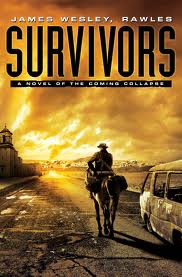
Book Review: Survivors

As previously mentioned, I had to get out of town for job preparations.  I got to the airport with very little spare time before boarding.  I popped into the book store, saw Survivors on the shelf, grabbed it, and ran to the gate.  Oh yeah, I paid for it too.  Quite a bit actually, everything is so much more expensive at the airport.

Survivors, James Wesley, Rawles

I read very quickly.  In between naps I finished this book in about 8 hours of flying.  After finishing this book, and reading the back flap, I realized that the author is also the author of one of the survival blogs I visit.  Actually, it is the survival blog, www.survivalblog.com.

Conceptually, there were a lot of very interesting things going on in this book.  One of the main characters is a military man, stationed over seas when SHTF.  One of the main story lines in the book is his epic journey to get back to his family.  There are also an interesting range of people in different scenarios and how they manage when the economy totally collapses in a very short period of time.

There were some interesting themes in this book, ones that should seem familiar to many who read survivalist blogs: the conspiracy about government controlling the economy, the UN trying to take over, gangs running rampant, and how gold, silver, and ammo are the only currencies that will be acceptable after SHTF.  There are some good survival tips and some cool suggestions on gear.

There is also a very large religious theme, pretty much every "good" character is very Christian.  When I finished the book, I theorized that if you removed every religious reference, ever bible quote, than the book would have been half as thick.  That might be fine for a lot of readers (especially those who are more familiar with his work), but I'm a very non-religious kind of guy and I found it a little too much.

Unfortunately, because I read so much, I'm also incredibly picky.

So, it's an entertaining book, it has some good points...  some readers (especially religious ones who are interested in the conspiracies about the economy) will probably enjoy this book.  As a non-religious guy, who isn't too big on conspiracy theories, this book was a little less than I was hoping for (especially at airport prices).  There isn't any character development, the book skips months at a time with no real changes, it's interesting but awkward.  And very religious.

If I'd paid $2-3 dollars in the kindle store for this book than I probably wouldn't care, but paying full list price +25% airport markup?  I'm not impressed.  And this is a "New York Times Best Seller"?  If you're looking for something to reaffirm standing religious/conspiracy beliefs than this book is perfect for you, if you're not, than this book probably won't blow your mind.


Wednesday, November 14, 2012

The Traveling Wrinkle

So, my recent travels have given me a few things to think about.  I mean, how much good does all your prepping do if you're thousands of miles away from them?  And what can you bring with you through airport security?  You can't even take fingernail clippers or lighters on the plane.


There are all sorts of links online for survival tins, either premade or directions for making your own.   I'll probably be making a generic one in the future, to put in my checked bags.  I thought about making one for this trip, but didn't have time to put together a good one.  Plus, I don't know where to go, have no knowledge of the local wild life and fauna, so what would I put in one?

So, what do you do?

Here are a few of the ideas I came up with:
  • Bring warm clothes and a decent rain jacket.  Maintaining body temp is a key to survival.  Hypothermia is a real risk in any climate if you get wet or have no protection from the elements.
  • Pick up some water as soon as you land.  Obviously you can't bring much with you on the flight, but you can get a couple big bottles at almost any gas station.
  • You can put a good knife, a first aid kit, and some cordage in your checked luggage.  You need to do some research on what the knife laws are where you are going, a Rambo survival knife might not be the smartest option.  I opted for a good little folder just to be on the safe side.
  • You can pick up a few staple food items when you land.  Trail mix, jerky, etc.  Personally, I didn't get much because, like the water, I can't take much back with me.
  • Pack good shoes and socks.  And maybe a foot care kit (tape, vaseline, moleskin, etc.)
  • You can pack a couple lighters in your checked bags, or get a couple at a gas station.
  • Cash.  Carry plenty of cash.  'Nuf said.
So, in a true survival situation you should have the basics covered.  Maintain core temperature, hydrate, first aid, start fires, and have a few food items.  It's not a BOB, it might not get you as far as your stock pile back home, but will hopefully be enough to get you through a short term survival scenario.


(Or you can be lucky like me and have a super-massive Sports Authority right next to the hotel.  It has a huge hunting section, I picked up a badass camo shell jacket today.  Score!)

Tuesday, November 13, 2012

Another Knife Thread: Lots of Pictures

 I know, I know... you're all tired of knife threads.  Yeah, right, the knife reviews are probably the only reason anyone shows up here.

Anyway, I decided that I wanted to do a kind of "budget" sheath knife review.  There are plenty of half way decent outdoor, hiking, camping knives that won't break the budget.  Here are a few I found, all under $40.

Gerber's Left to Right:  Profile Fixed $25, Freeman Guide $32, Big Rock Serrated $37

There are plenty of other good, cheap knives that could have easily fit in to this post, but it turned out that the three I could get my hands on were all Gerber knives.  I'm not usually a fan of Gerber, I find that their quality is kind of hit or miss.  I've had $20 Gerber folders that worked great and $40 dollar ones that I hated.  Unlike some brands, you have to really get your hands on the knife before you can get a feeling about the quality.  However, in my short time looking for 'discount' sheath knives, these were the easiest to get a hold of.  

All of these are full tang sheath knives, each would probably work relatively well on a camping trip or bug out.  However, each one of these three has a different style blade, grip, and sheath.  Ultimately you have to try out a few different types to see what you like best, but I'll go over a few things that I look for when buying a knife, especially if it's relatively cheap.


Gerber Profile Fixed $25

This is a pretty cool looking knife for the price.  This knife has a lot of metal, which I consider a good thing.  It's heavy, which is a preference of mine.  A sharp blade with some weight behind it requires less effort to use.  A sharp blade with less weight means you have to push harder to get the same result.  That's the experience I've had.


The handle is a little bit of a negative for me on this knife.  You can see in the photo above, if I keep my fingers together my middle finger hits one of the points on the handle.


If I separate my first finger, look where my pinkie ends up.  For my hand type, this handle is a little awkward to use.  I can make it work but it would throw me off.   The next problem I had was with the sheath.


It's made of what looks like quality material, but this style is like two pieces of plastic sewn together around the edges with fabric on the outside.  It's totally flat.  It holds the knife, it's probably pretty durable, but you have to basically force the blade between the two pieces of plastic sewn together.


The sheath isn't a deal breaker to me.  I mean, how hard is it to replace a sheath?  With this knife I would probably swap it out.


Gerber Freeman Guide $32:

This is a slightly more conventional looking knife.  Right off the bat, look at the difference in how the handle fits my hand.  Definitely more comfortable for hands my size.


Like a glove, as Ace Ventura would say.  I really like the shape of the blade, the fit in my hand.  The only complaint I had with the knife itself was the textured area on the back of the blade.  It's hard to see in the photos, but there are notches in the metal where you would put your thumb if you were carving.  Those notches were annoying, and seemed like they would probably tear up your thumb if you were whittling for a while.

Now, lets look at the sheath.


What the heck is this thing?  It looks like it's built for a knife twice this size, or a machete, or something.


Yeah, it covers almost the entire knife.  It's super easy to slide the blade into the sheath... it's getting it back out that's awkward.  I went with two fingers, tweezers-like, on the big metal piece at the bottom of the handle to pull it up high enough to grab it better.  Not easy.

Again, it isn't a deal breaker, but it's annoying.


Gerber Big Rock Serrated $37:

Again, look at the difference in the layout of the grip.  It felt a lot like the Freeman Guide, but it was thicker and I like that better.  If the handle isn't a hand full than the knife usually feels too small for me.  I like big handles and I will not lie.


Over all it seemed like a nice knife.  The only thing that was a little weird was the knob (my thumb is on it in the above photo), it looks kind of funny and might or might not be comfortable when carving with the knife.  It's hard to tell without using it for a while and I haven't had an excuse to use it yet.

And the sheath?


This sheath is surprisingly good after the complaints I had with the first two.  It has a plastic form for the blade inside the fabric.  The knife slides in, easy as pie, doesn't slide around, and secures nicely.  It's not the prettiest sheath, but I probably wouldn't swap this one out.  The only complaint I had with the sheath is how big the belt loop is, it starts where the blade ends and goes all the way up to the top.  I'm not sure if that would cause problems with the sheath sliding around, or it is just convenient for people who like big belts.  Just something to watch.


Here's the three knives, side by side.  Pretty easy to see the differences in the blades and handles.

The three sheaths, side by side.  


I was amazed at how different they all were.  The first and third look similar, but the first is completely flat and the third has the plastic form inside so it is way thicker, it's easier to get the knife in and out.

Any of these three knives would make a decent choice for the budget camper.  They're all full tang, decently sharp, seemingly well made blades.  They're all under $40 and readily available at a lot of outdoor stores and online.  

I wanted to do this post to show you some of the things to look for when determining basic knife quality.  I wanted to look at the differences between common sheath knives and show how important it is to really handle them, get a feel for them, to see which types work best for you.  Remember, these are camping/outdoor knives, practical knives.  If you want something a little more intimidating, there are other options.